
Optical Rotation Testing Services
Optical rotation measurements determine the specific rotation of chiral compounds using polarimetry.
Our Jasco P-2000 polarimeter measures how chiral molecules rotate plane-polarized light, providing essential characterization data for pharmaceuticals, natural products, and research compounds. This non-destructive technique is critical for confirming chirality, assessing purity, and determining enantiomeric composition.
Our Polarimeter
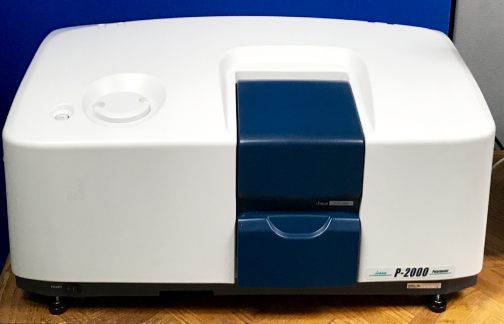
Jasco P-2000 Digital Polarimeter
High-precision optical rotation measurements
Instrument Specifications:
- Light source: Sodium lamp (589 nm, D-line)
- Wavelength: 589 nm (standard for specific rotation)
- Temperature control: 15-40°C (Peltier system)
- Accuracy: ±0.02° (up to 1°) ±0.2° (larger than 1°)
- Sample recovery: Yes (non-destructive)
Available Sample Cells
3.5 × 100 mm Cell
- Volume: 3 mL
- Path length: 100 mm (1 dm)
- Best for: Small sample amounts, higher concentrations
10 × 100 mm Cell
- Volume: 10 mL
- Path length: 100 mm (1 dm)
- Best for: Larger volumes, lower concentrations
How Optical Rotation Works
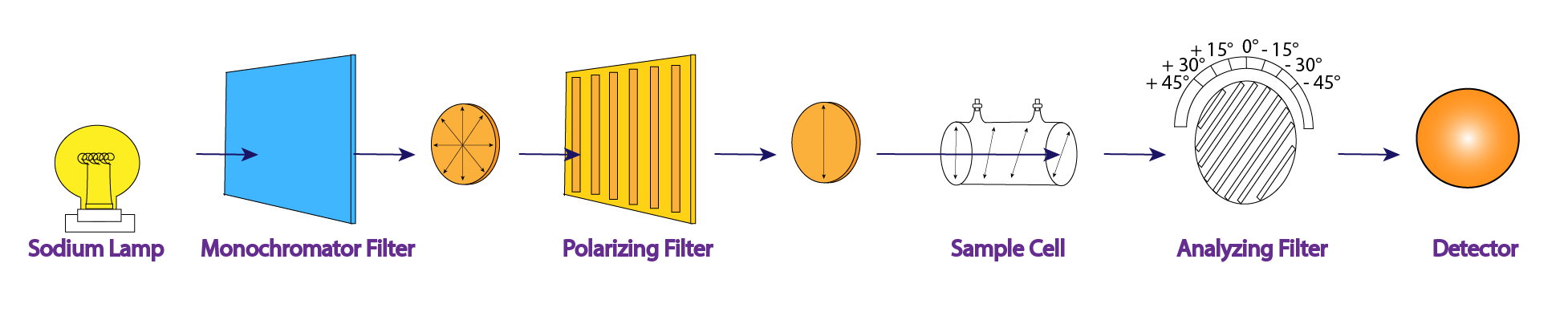
The Principle of Polarimetry
A polarimeter measures the rotation of plane-polarized light caused by optically active (chiral) substances.
The Process:
- Light source - Monochromatic light (589 nm sodium D-line) is generated
- Polarization - Light passes through a polarizing filter, creating plane-polarized light
- Sample interaction - Polarized light passes through the sample cell containing your chiral compound in solution
- Rotation - Chiral molecules rotate the plane of polarization by a specific angle
- Detection - A second polarizing filter (analyzer) measures the angle of rotation
- Calculation - The instrument calculates specific rotation [α]
Dextrorotary (+)
Clockwise rotation (to the right)
- Designated with (+) sign
- Also called "d-" or "dextro-"
- Example: (+)-glucose, dextrose
Levorotary (-)
Counter-clockwise rotation (to the left)
- Designated with (-) sign
- Also called "l-" or "levo-"
- Example: (-)-fructose, levulose
Specific Rotation [α]
Understanding Specific Rotation
Specific rotation [α] is an intrinsic property of a chiral compound, independent of concentration and path length.
The Formula:
[α]λT = α / (l × c)
Where:
- [α] = Specific rotation (in degrees × mL × g⁻¹ × dm⁻¹)
- α = Observed rotation (in degrees, measured by instrument)
- l = Path length (in decimeters, dm; typically 1 dm = 10 cm = 100 mm)
- c = Concentration (in g/mL)
- λ = Wavelength (typically 589 nm, the sodium D-line)
- T = Temperature (typically 20°C or 25°C)
Standard Notation:
Specific rotation is reported as: [α]D25
- D = sodium D-line (589 nm)
- 25 = temperature in °C
Example:
[α]D25 = +52.7° (c = 1.0, CHCl₃)
This means: specific rotation is +52.7° measured at 25°C using sodium D-line light, with a concentration of 1.0 g/100 mL in chloroform.
Applications of Optical Rotation
Pharmaceutical Applications
- Compound identification - Confirm identity by matching literature values
- Enantiomeric purity - Assess optical purity and ee% (enantiomeric excess)
- Quality control - Verify active pharmaceutical ingredients (APIs)
- Chiral resolution monitoring - Track separation efficiency
- Stability studies - Monitor racemization over time
Research & Natural Products
- Natural product characterization - Identify and verify compounds
- Synthetic chemistry - Confirm stereochemistry of products
- Amino acids and peptides - Verify L- or D-configuration
- Carbohydrates - Distinguish D- and L-sugars
- Terpenes and alkaloids - Essential oil analysis
Determining Enantiomeric Excess (ee%)
What is Enantiomeric Excess?
Enantiomeric excess (ee) quantifies the purity of one enantiomer over the other in a mixture.
Calculation from Optical Rotation:
ee% = ([α]observed / [α]pure) × 100
Example:
If pure (+)-limonene has [α]D25 = +126° and your sample measures +100°:
ee% = (100 / 126) × 100 = 79.4% ee
This means your sample is 79.4% enantiomerically pure (89.7% (+)-enantiomer, 10.3% (-)-enantiomer).
Important Notes:
- Requires knowing the [α] of the pure enantiomer (from literature or reference sample)
- Assumes no other optically active impurities are present
- Temperature and solvent must match reference conditions
- For more precise ee determination, use chiral HPLC or chiral NMR
Sample Requirements
What You Need to Provide
Sample Amount:
- For 3.5 mm cell: 30mg minimum if running at standard concentration (depends on optical activity and if trying to match literature values)
- For 10 mm cell: 100 mg minimum if running at standard concentration
- More material may be needed for weakly rotating compounds
Solvent:
- Sample must be completely soluble
- Common solvents: chloroform, methanol, ethanol, water, DMSO
- Specify your preferred solvent or we can recommend one
- Solvent should be optically inactive (achiral)
Concentration:
- Typical: 0.1 - 10 g/100 mL (0.001 - 0.1 g/mL)
- Higher concentrations for weakly rotating compounds
- Lower concentrations for strongly rotating compounds
Temperature:
- Standard: 20°C or 25°C
- Can accommodate 15-40°C range
- Specify if you need a specific temperature to match literature
What You'll Receive
Standard Report Includes:
- Specific rotation [α]DT (if requested)
- Observed rotation α (in degrees) (if requested)
- Concentration (in g/100 mL or g/mL)
- Solvent used
- Temperature (typically 20°C or 25°C)
- Path length (cell size used)
- Wavelength (589 nm, sodium D-line)
- Sign (+ for dextrorotary, - for levorotary)
Optional Analysis:
- Multiple temperatures - Temperature dependence study
- Multiple concentrations - Verify linearity
- Time course - Stability or racemization monitoring
- Enantiomeric excess calculation - If pure reference value is known
Turnaround Time & Pricing
Standard Turnaround: 2-3 business days
Rush Service: Same-day or next-day available upon request (2x normal price)
Optical rotation is often ordered together with FTIR spectroscopy. For pricing information, please request a quote or contact us.
Learn More About Optical Rotation
- Chirality and Optical Rotation - Purdue University educational resource
- Jasco P-2000 Polarimeter - Instrument specifications
Need Optical Rotation Measurements?
Submit your chiral compounds for professional polarimetry analysis
Submit a Sample Request a Quote
Phone: (858) 793-6057 | Email: NuMegaLab@NuMegaLabs.com
Related Services
FTIR Spectroscopy
Often ordered together
H-1 NMR
Structure verification
Mass Spectrometry
Molecular weight
Elemental Analysis
Purity assessment