
FTIR Spectroscopy Testing Services
FTIR (Fourier Transform Infrared) spectroscopy identifies functional groups and characterizes molecular structure through infrared absorption.
FTIR is a fast, non-destructive analytical technique that provides a molecular "fingerprint" by measuring the vibrational frequencies of chemical bonds. Essential for organic compound identification, polymer analysis, and quality control.
Our FTIR Instrument
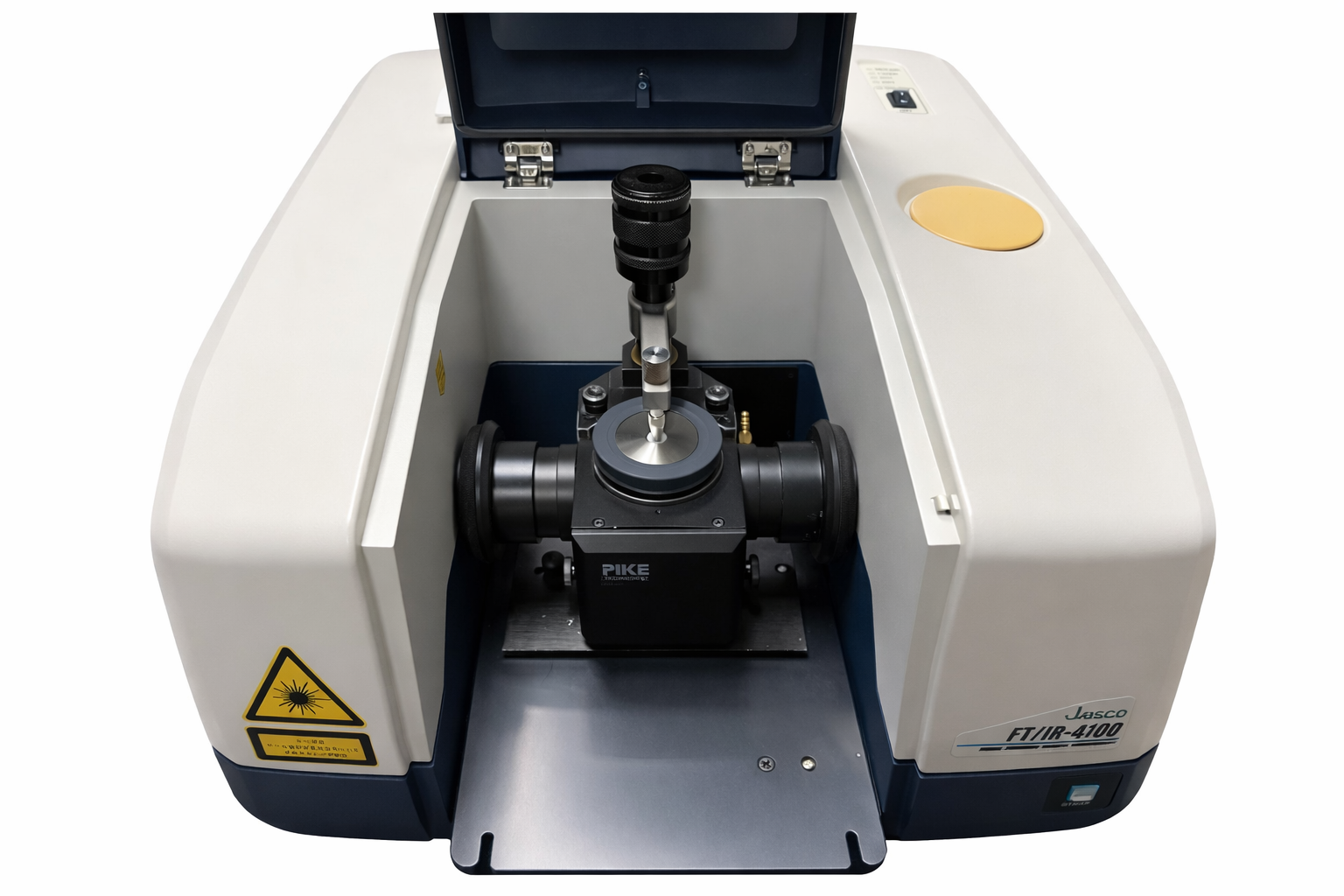
Jasco FTIR 4100
High-performance infrared spectrometer with ATR sampling
- ATR Accessory: ZnSe crystal (no sample prep required)
- Range: 4000-600 cm⁻¹
- Resolution: 0.9 cm⁻¹
- Accuracy: ±0.01 cm⁻¹
- Source: High-intensity ceramic
- Optical System: 45° Michelson interferometer
Permanent optical alignment with vibration-proof bench
What is FTIR Spectroscopy?
FTIR spectroscopy measures the absorption of infrared light by molecules. Different chemical bonds absorb at characteristic frequencies, creating a unique spectral "fingerprint" for each compound.
What FTIR Reveals
- Functional groups - C=O, O-H, N-H, C-H, triple bonds, etc.
- Bond types - Single, double, triple bonds
- Molecular structure - Aromatic vs aliphatic
- Compound identity - Spectral fingerprinting
- Purity - Detect impurities and contaminants
- Hydrogen bonding - Intermolecular interactions
Key Advantages
- Fast analysis - Results in minutes
- Non-destructive - Sample remains intact
- Minimal sample - Micrograms sufficient
- No sample prep - ATR requires no preparation
- Versatile - Solids, liquids, powders, films
- Complementary to NMR - Different structural info
How FTIR Spectroscopy Works
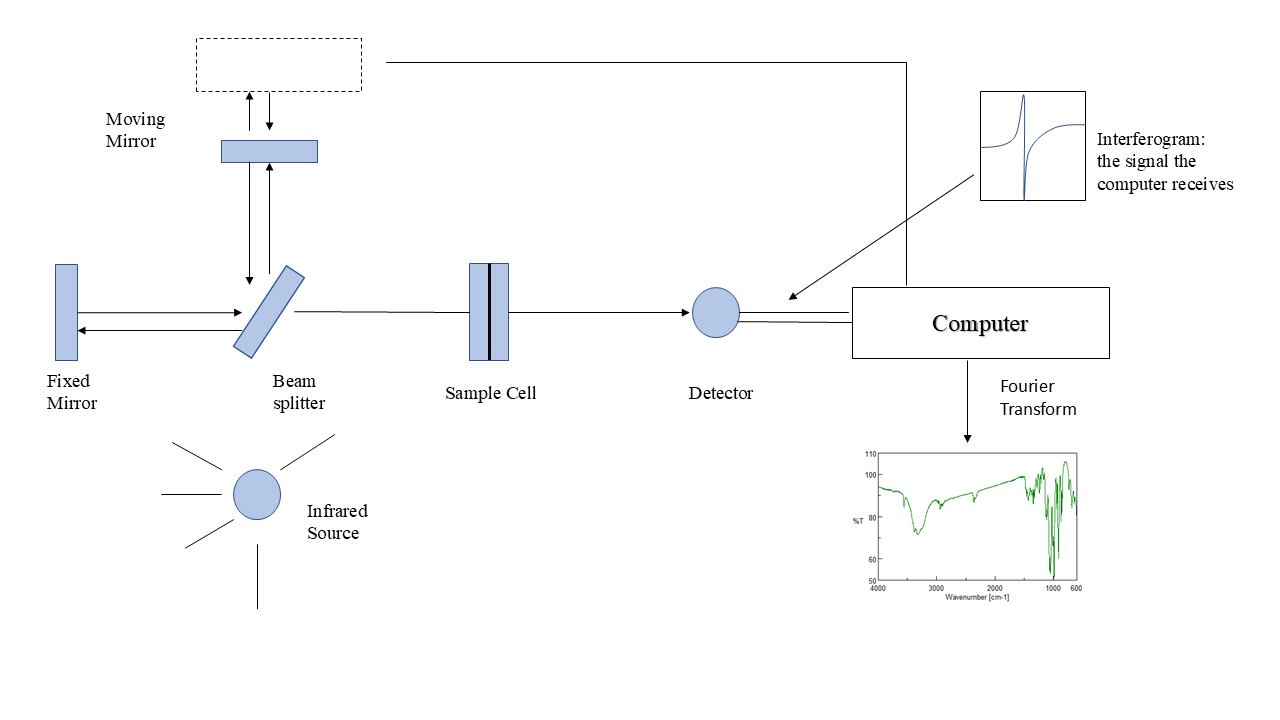
The FTIR Process
- Infrared source - High-intensity ceramic source emits IR light
- Beam splitter - Splits light into two paths at 45°
- Interferometer - Creates interference pattern (interferogram)
- Sample interaction - IR light passes through sample on ATR crystal
- Detection - Detector measures transmitted/reflected light
- Fourier Transform - Computer converts interferogram to spectrum
ATR-FTIR (Attenuated Total Reflectance)
Our instrument uses ATR sampling, which offers major advantages:
- No sample preparation - Place sample directly on crystal
- Solid or liquid - Works with any sample form
- Non-destructive - Sample recovered after analysis
- Small sample size - Only need to cover crystal surface
- Reproducible - Consistent results
How ATR works: Infrared beam reflects internally in the ZnSe crystal. Sample in contact with the crystal absorbs IR at characteristic frequencies, and the reflected beam is analyzed.
Characteristic IR Absorption Frequencies
| Functional Group Class | Bond / Vibration Type | Absorption Range (cm⁻¹) | Signal Appearance & Intensity |
|---|---|---|---|
| Alkanes | C-H stretch | 2850 - 2960 | Medium to Strong, Sharp |
| Alkenes | =C-H stretch C=C stretch |
3010 - 3100 1620 - 1680 |
Medium, Sharp Variable, Sharp |
| Alkynes | ≡C-H stretch C≡C stretch |
~3300 2100 - 2260 |
Strong, Sharp Variable, Sharp |
| Alcohols & Phenols | O-H stretch (hydrogen bonded) | 3200 - 3550 | Strong, Broad |
| Carboxylic Acids | O-H stretch C=O stretch |
2500 - 3300 1705 - 1720 |
Strong, Very Broad Strong, Sharp |
| Ketones & Aldehydes | C=O stretch | 1670 - 1740 | Strong, Sharp |
| Esters | C=O stretch C-O stretch |
1735 - 1750 1000 - 1300 |
Strong, Sharp Strong, Sharp |
| Amides | C=O stretch N-H stretch |
1630 - 1690 3140 - 3500 |
Strong, Sharp Medium, Sharp/Broad |
| Amines | N-H stretch C-N stretch |
3300 - 3500 1080 - 1360 |
Medium, Sharp/Broad Medium to Strong, Sharp |
| Nitriles | C≡N stretch | 2210 - 2260 | Medium, Sharp |
| Nitro Compounds | N-O asymmetric stretch N-O symmetric stretch |
1515 - 1565 1345 - 1385 |
Strong, Sharp Strong, Sharp |
Common Applications of FTIR
Organic Chemistry
- Functional group identification
- Reaction monitoring - Track functional group changes
- Purity assessment - Detect impurities
- Product verification - Confirm expected structure
- Unknown identification - Library matching
Polymer & Materials Science
- Polymer identification - Fingerprint analysis
- Additives and plasticizers
- Degradation studies - Oxidation, aging
- Composite materials
- Surface coatings - Films and layers
Pharmaceutical & Quality Control
- API identification - Active ingredients
- Formulation analysis
- Contaminant detection
- Batch-to-batch consistency
- Excipient verification
Other Applications
- Environmental samples
- Food chemistry - Authenticity testing
Sample Requirements
ATR-FTIR Sample Requirements
One of the easiest analytical techniques - minimal requirements:
- Sample amount: Micrograms to milligrams (enough to cover crystal)
- Sample form: Solid, liquid, powder, film, gel - all acceptable
- Sample preparation: None required for ATR
- Sample condition: Can be analyzed as-is
- Sample recovery: Yes - non-destructive analysis
Best Practices
- For solids: Clean, dry surface for best contact with crystal
- For liquids: A drop is sufficient
- For powders: Press gently onto crystal
- For films: Place directly on crystal surface
Turnaround Time & Pricing
Standard Turnaround: 1-3 business days
Rush Service: Same-day or next-day available upon request for an additional fee
For pricing information, please see our pricing page or contact us.
What You'll Receive
Standard Deliverables
- FTIR spectrum (4000-600 cm⁻¹)
- Peak table with assignments
- PDF report
- Raw data files (if requested in .csv format)
FTIR vs NMR: Complementary Techniques
When to Use FTIR vs NMR
FTIR is best for:
- Quick functional group identification
- Minimal sample available
- Solid samples (no need to dissolve)
- Fast screening or quality control
- Polymer and material characterization
- Non-destructive analysis required
NMR is best for:
- Complete structure determination
- Detailed molecular connectivity
- Quantitative analysis
- Isomer differentiation
- Complex mixture analysis
Use both together for comprehensive characterization - FTIR provides functional groups, NMR provides detailed structure!
Ready for Fast Functional Group Analysis?
Submit your samples for FTIR spectroscopy analysis
Submit a Sample Request a Quote
Phone: (858) 793-6057 | Email: NuMegaLab@NuMegaLabs.com
Related Services
H-1 NMR
Complete structure determination
Mass Spectrometry
Molecular weight confirmation
Optical Rotation
Often ordered together
Elemental Analysis
Elemental composition